In the quiet, humidity-controlled ateliers of northern Vietnam, master artists speak of lacquer painting not as an act of drawing, but as an act of excavation. The term Sơn Mài is a compound formed by two Vietnamese verbs: Sơn (to apply natural sap) and Mài (to sand or polish under running water). It represents one of the most distinctive contributions of Southeast Asia to world fine arts.
I. The Botanical Foundation: Sơn Ta Resin
The entire medium depends on the sap harvested from the Toxicodendron succedaneum (locally known as Cây Sơn), cultivated predominantly on the terraced red-soil hills of Tam Nông in Phú Thọ Province. Farmers tap the trees at dawn before sunlight breaks the chemical equilibrium of the resin.
When initially tapped, the sap is a milky, translucent liquid. It is left to settle in giant ceramic vats for several months, naturally separating into distinct strata:
- Sơn Nhất (First Quality): The clear, amber-tinted top layer, prized for protective topcoats and luminous glazes.
- Sơn Nhì & Sơn Ba (Lower Grades): Heavier, opaque resins mixed with sawdust and alluvial river clay to seal and waterproof the wooden core boards.
- Sơn Then (Deep Jet Black): Formed by stirring natural sap in an iron cauldron with a pine wood spatula for upwards of 48 continuous hours, reacting with ferrous ions to achieve deep obsidian darkness without artificial dyes.
The 1925 Fine Arts Revolution in Hanoi
Prior to the 1920s, lacquer was primarily an applied protective craft for Buddhist temple statuary, palanquins, and imperial furniture. In 1925, masters at the École des Beaux-Arts de l'Indochine in Hanoi — notably Nguyễn Gia Trí, Trần Quang Trân, and Phạm Hậu — revolutionized the medium by introducing wet sandpaper grinding, gold leaf gilding, and eggshell mosaics, transforming craft into pure pictorial fine art.
II. The Anatomical Stages of Creation
A true Vietnamese Sơn Mài panel demands between three to six months of painstaking labor across 20 distinct procedures. Below are the key anatomical phases:
Bó Hom: Building the Impermeable Core
Solid aged jackfruit wood (Gỗ Mít) or high-density timber is enveloped in natural ramie gauze, sealed with five coats of raw sap and alluvial mountain clay to prevent warping against tropical humidity fluctuations.
Cẩn Vỏ Trứng: Duck Eggshell & Pearl Inlay
Eggshells from unhatched ducklings are washed, charred to achieve subtle gradients of ivory and sepia, broken with needle tips, and embedded into wet sap one fragment at a time to form highlights.
Dát Vàng & Dát Bạc: Gold and Silver Dusting
Sheets of 24-karat gold leaf (Vàng Quỳ) beaten paper-thin in the Kiêu Kỵ guild are laid upon tacky resin, followed by cinnabar (Son Đỏ) and charcoal dust.
Mài Dưới Nước: Submerged Grinding & Revelation
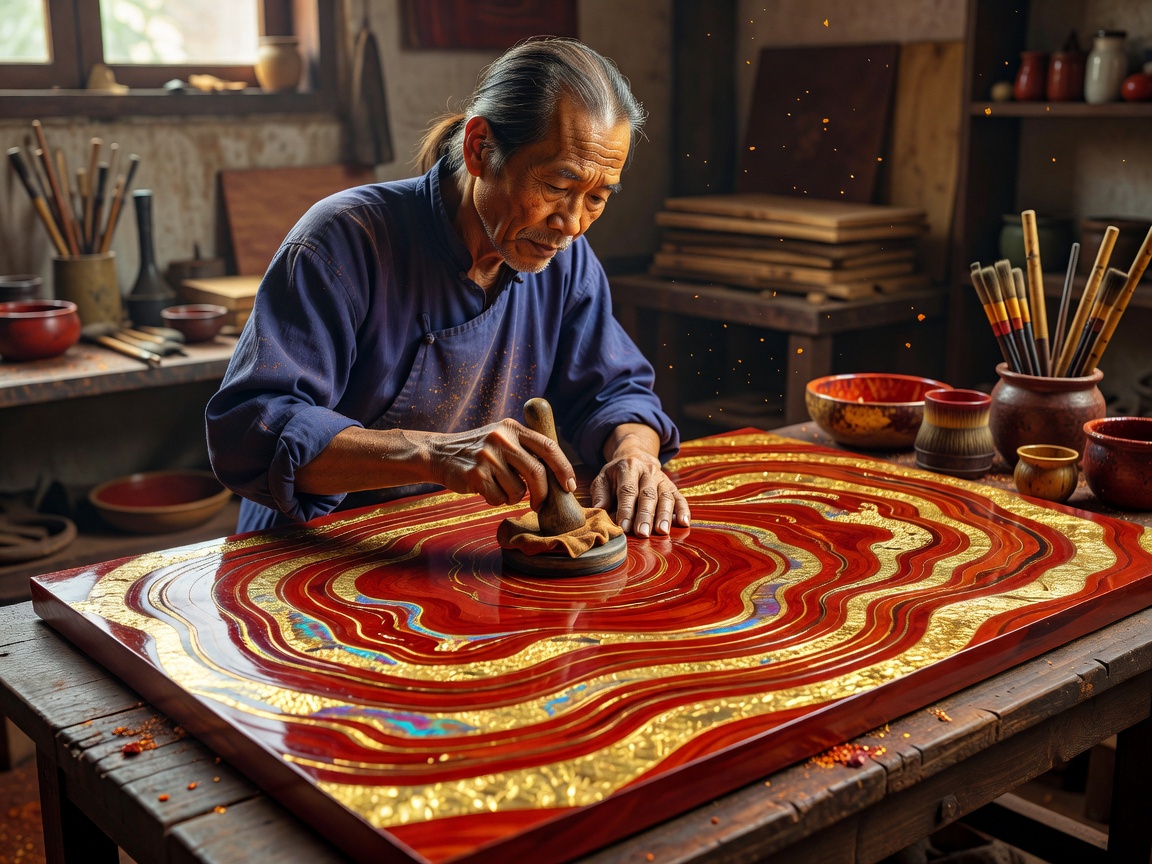
The panel is completely covered in black lacquer until all colors disappear. The artist then grinds the surface under running water using charcoal blocks and wet fine-grit papers, coaxing the buried gold, pearl, and eggshells back to visibility.
III. The Paradox of Water Sanding
The final brilliance of Sơn Mài is achieved without chemical synthetic varnishes. Master craftsmen polish the fully cured panel using the palm of their bare hands lubricated with fine charcoal powder and deer horn ashes (bột tro sừng hươu). The friction creates a natural, refractive glaze that deepens with age, resisting water, heat, and insects for centuries.